

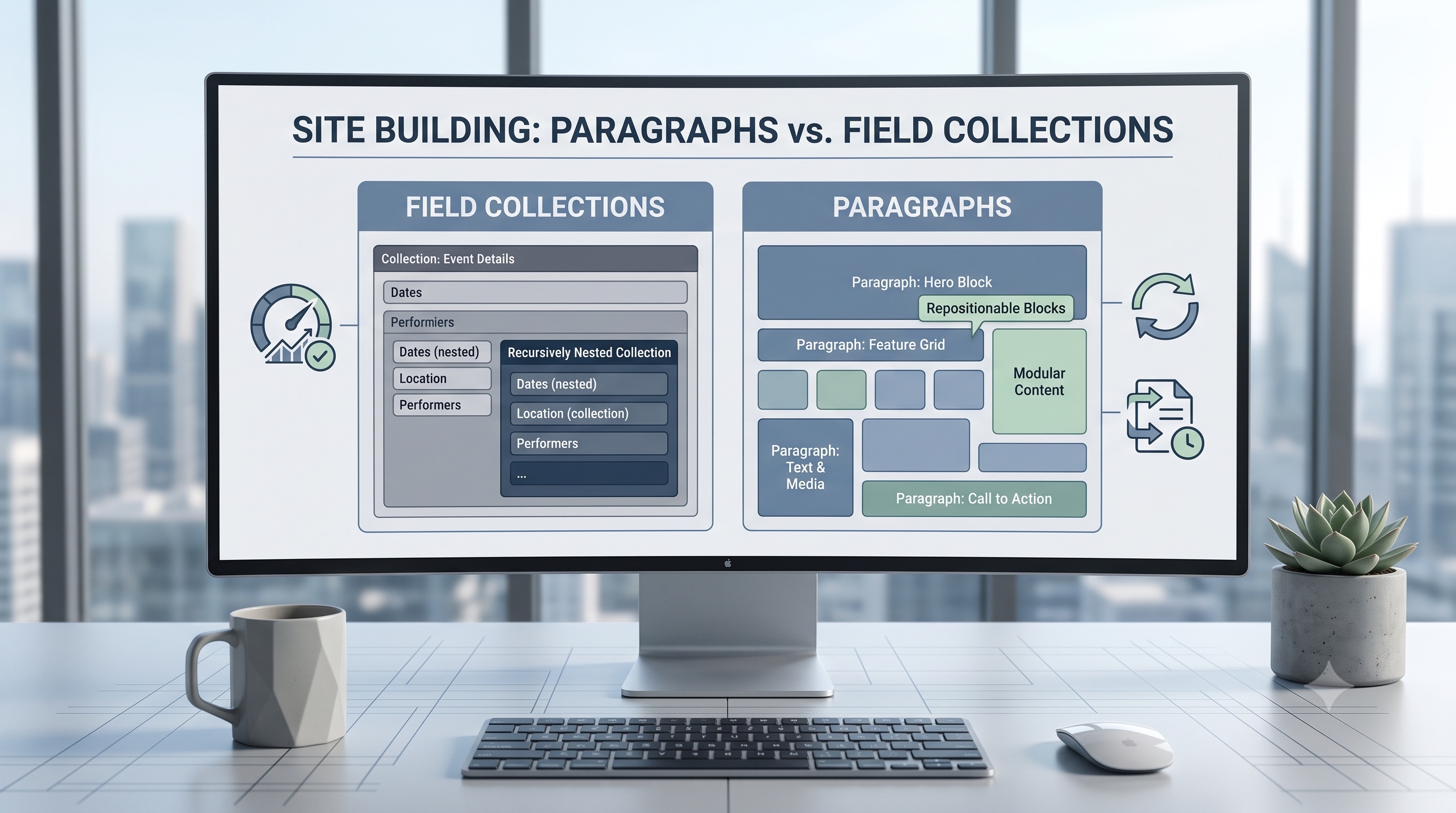
Choosing between paragraphs and field collections is not a binary decision; it depends on the specific needs of the site, the editorial workflow, and performance considerations. Paragraphs excel in scenarios that demand reuse, independent revisions, and fine‑grained access control. Field collections shine when simplicity, low overhead, and rapid development are the primary goals. By applying the outlined best practices and decision framework, development teams can construct robust, maintainable content models that align with both business objectives and technical constraints.
Introduction
When constructing a content‑rich website, developers often face a choice between using simple paragraph fields or more complex field collections. Both approaches have distinct implications for data modeling, editorial workflow, and site performance. Understanding the trade‑offs helps teams select the right strategy for their project’s requirements, maintainability, and scalability. This article examines the technical characteristics of paragraphs and field collections, compares their strengths and limitations, and provides practical guidance for making an informed decision.
Understanding the Core Concepts
What Are Paragraphs?
Paragraphs are reusable, component‑based entities that allow content editors to assemble pages from a set of predefined building blocks. Each paragraph type encapsulates a specific layout or functionality, such as a text block, image carousel, or call‑to‑action button. Paragraphs are stored as separate entities, which means they can be reused across multiple nodes and can have their own fields, validation rules, and display settings.
What Are Field Collections?
Field collections group multiple fields together into a single logical unit that can be attached to a parent entity. Unlike paragraphs, field collections do not exist as independent entities; they are embedded directly within the parent node. A field collection might contain a title, image, and caption that together represent a feature item. Because they are nested, field collections are often perceived as a lightweight alternative to paragraphs for simple groupings of fields.
Technical Comparison
Data Structure
- Paragraphs: stored as separate rows in the database, each with its own entity ID.
- Field Collections: stored as a serialized array within the parent entity’s table, without a distinct entity ID.
Reusability
- Paragraphs can be referenced by multiple nodes, enabling true content reuse.
- Field collections are bound to a single parent; reuse requires duplication.
Revision Control
- Paragraphs support independent revision tracking, allowing editors to revert changes at the component level.
- Field collections inherit the parent’s revision history; changes are tracked only at the node level.
Access Control
- Paragraphs can have granular permissions based on entity type.
- Field collections rely on the parent’s permissions, limiting fine‑grained control.
Performance
- Paragraphs introduce additional joins when rendering, which may increase query complexity for large pages.
- Field collections reduce join overhead but can lead to larger serialized blobs, affecting cache efficiency.
Migration and Portability
- Paragraphs are compatible with migration tools that recognize entity structures, simplifying site upgrades.
- Field collections often require custom migration scripts due to their nested storage format.
When to Choose Paragraphs
Select paragraphs when the project demands any of the following:
- Component Reuse across multiple pages or content types.
- Independent Revision History for tracking changes to specific sections.
- Fine‑Grained Permissions that vary by component type.
- Complex Layouts that involve nested entities, such as accordions with dynamic content.
Example Use Cases
- A marketing site with reusable hero banners that appear on the homepage, product pages, and landing pages.
- An editorial platform where authors need to edit and version individual quote blocks without affecting the surrounding article.
- A multilingual site where translation workflows require separate handling of each paragraph type.
When to Choose Field Collections
Field collections are appropriate in scenarios where simplicity and performance are paramount:
- Simple Groupings of fields that are unlikely to be reused elsewhere.
- Low‑Volume Content where the overhead of additional entities is unnecessary.
- Rapid Prototyping where developers need a quick way to bundle fields without creating full paragraph types.
Example Use Cases
- A product specification table that appears only on a single product node.
- A one‑off testimonial block that does not need to be shared across other pages.
- A quick event listing where the title, date, and location are stored together without separate entity management.
Best Practices for Implementation
Planning the Content Model
1. Map out all page components and identify which ones will be reused.
2. Categorize components by complexity; simple field groups can be candidates for field collections.
3. Document revision and permission requirements for each component.
Configuring Paragraphs
- Create a dedicated paragraph type for each reusable component.
- Define field validation rules that reflect the component’s purpose.
- Set display modes that align with the site’s design system.
Configuring Field Collections
- Use field collections for tightly coupled fields that belong together logically.
- Keep the number of fields within a collection minimal to avoid bloated storage.
- Ensure that the parent entity’s display settings render the collection cleanly.
Performance Optimization
- Enable entity caching for paragraphs to mitigate the cost of additional joins.
- Use view modes that limit the number of fields rendered per component.
- Regularly audit the number of paragraph instances on high‑traffic pages.
Migration Strategy
- When moving from field collections to paragraphs, export existing data using a custom script that maps collection fields to paragraph fields.
- Validate the migration in a staging environment before applying to production.
Decision Framework
Below is a concise checklist to help teams decide between paragraphs and field collections:
- **Reuse Required?**
- Yes → Paragraphs
- No → Field Collections
- **Independent Revision Needed?**
- Yes → Paragraphs
- No → Field Collections
- **Granular Permissions Needed?**
- Yes → Paragraphs
- No → Field Collections
- **Component Complexity?**
- High (nested, dynamic) → Paragraphs
- Low (simple grouping) → Field Collections
- **Performance Sensitivity?**
- High traffic page with many components → Evaluate caching for paragraphs or prefer field collections for simple data.
Conclusion
Choosing between paragraphs and field collections is not a binary decision; it depends on the specific needs of the site, the editorial workflow, and performance considerations. Paragraphs excel in scenarios that demand reuse, independent revisions, and fine‑grained access control. Field collections shine when simplicity, low overhead, and rapid development are the primary goals. By applying the outlined best practices and decision framework, development teams can construct robust, maintainable content models that align with both business objectives and technical constraints.