
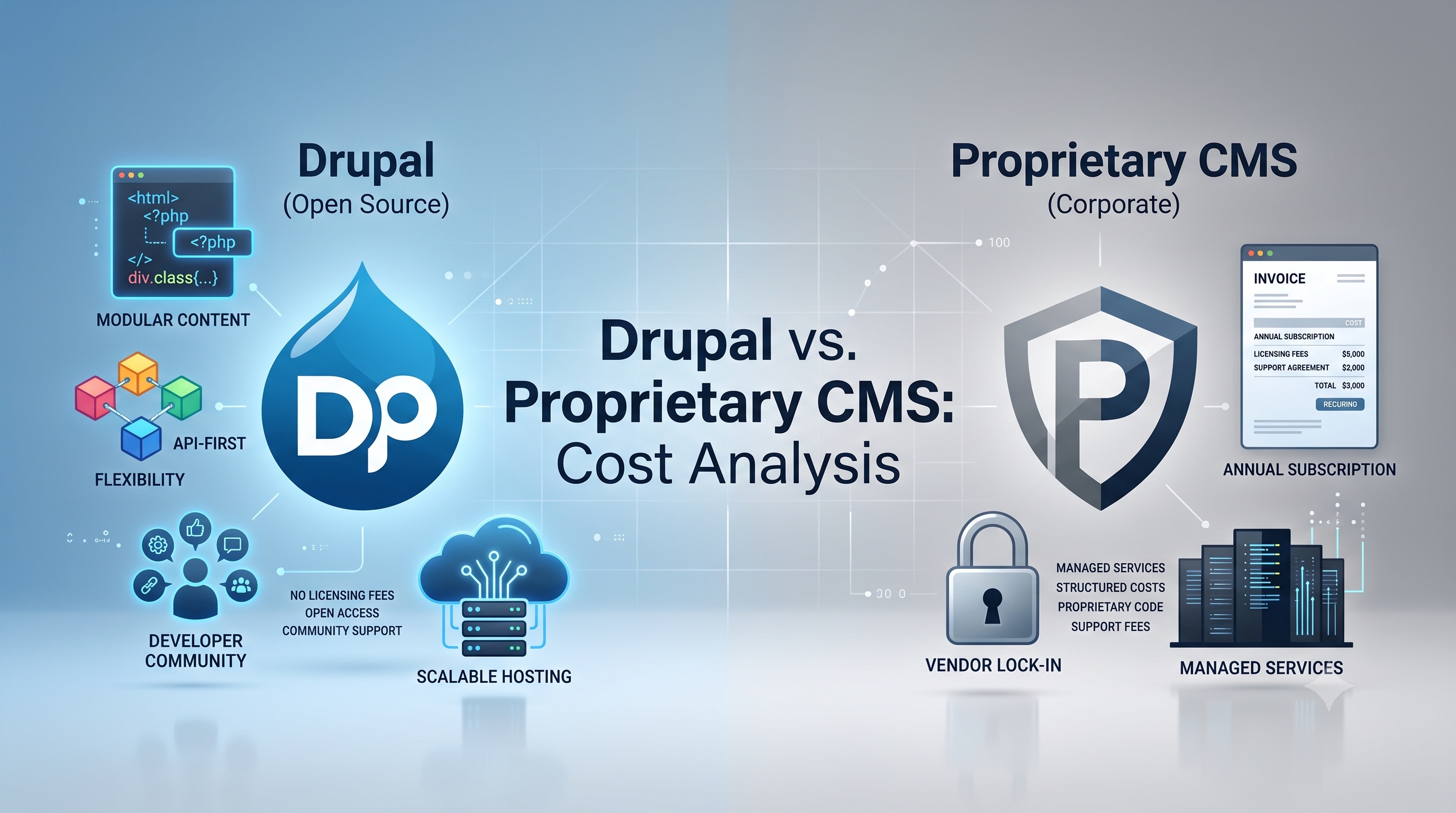
Cost analysis reveals that Drupal and proprietary CMS platforms occupy distinct financial niches. Drupal offers a low‑license, high‑flexibility model that can deliver substantial savings when an organization can invest in skilled development and manage its own infrastructure. Proprietary CMS solutions provide convenience, predictable subscription pricing, and vendor‑managed maintenance, but they often carry higher long‑term expenses and create dependency on the vendor’s ecosystem. By dissecting licensing, development, hosting, support, and training costs, decision‑makers can calculate a realistic total cost of ownership and choose the platform that best fits both budget constraints and business objectives.
Introduction
Choosing a content management system (CMS) is a strategic decision that impacts budget, time to market, and long‑term flexibility. Two broad categories dominate the market: open‑source platforms such as Drupal and proprietary solutions that require licensing fees. While functionality, security, and scalability are common comparison points, cost remains the most decisive factor for many organizations. This article provides a detailed cost analysis that separates upfront expenses from ongoing commitments, allowing decision‑makers to evaluate total cost of ownership (TCO) for Drupal and typical proprietary CMS options.
Defining the Cost Categories
Licensing and Subscription Fees
- Drupal: Free to download and use under the GNU GPL license. No per‑site or per‑user fees.
- Proprietary CMS: Typically charged per‑instance, per‑user, or per‑page view. Subscription models may include tiered pricing based on features, traffic volume, or support level.
Development and Implementation
- Drupal
- Requires skilled developers familiar with PHP, Symfony, and Drupal’s module architecture.
- Initial build time can be longer due to custom module development or extensive configuration.
- Community‑driven modules reduce the need for custom code in many cases.
- Proprietary CMS
- Often provides out‑of‑the‑box templates and drag‑and‑drop editors that accelerate implementation.
- Vendor‑provided professional services may be mandatory for complex integrations, adding to cost.
- Licensing fees sometimes include a limited number of development hours.
Hosting and Infrastructure
- Drupal
- Can be hosted on any compatible server environment, from shared hosting to cloud platforms.
- Organizations have full control over scaling, security patches, and performance tuning.
- Cloud‑native options such as Drupal on Kubernetes can increase operational complexity but also provide cost efficiencies at scale.
- Proprietary CMS
- Many vendors offer managed hosting as part of the subscription.
- Managed services simplify maintenance but lock the site into the vendor’s infrastructure, often at a premium.
- Scaling may require moving to higher‑priced tiers.
Maintenance and Support
- Drupal
- Community support is free, but enterprise‑grade support requires a paid plan from Drupal vendors or third‑party agencies.
- Security updates are released regularly; applying them is an internal responsibility unless a support contract is in place.
- Proprietary CMS
- Support is typically bundled with the subscription, offering SLA‑backed response times.
- Security patches are applied automatically on managed platforms, reducing internal workload.
Training and Skill Development
- Drupal
- Learning curve is steeper due to its flexible architecture and terminology.
- Training costs include workshops, certification programs, and time spent on knowledge transfer.
- Proprietary CMS
- Vendor‑provided training portals and certification tracks are often included.
- User interface is designed for non‑technical content editors, reducing onboarding time.
Total Cost of Ownership (TCO) Overview
*Note: Figures are illustrative averages for mid‑size enterprises; actual costs depend on scope, geography, and vendor negotiations.*
In‑Depth Comparison
1. Upfront Investment
Drupal’s zero licensing cost makes it attractive for organizations with limited capital. However, the need for experienced developers can raise initial development budgets. Proprietary CMS platforms often offset higher licensing fees with faster implementation cycles, especially when pre‑built modules meet business requirements out of the box.
2. Scalability and Long‑Term Expenses
Because Drupal can be deployed on any infrastructure, organizations can optimize hosting costs as traffic grows. Cloud providers offer pay‑as‑you‑go models that align expenses with usage. Proprietary CMS platforms may impose scaling fees or require migration to higher service tiers, which can cause sudden cost spikes.
3. Risk Management
Open‑source communities release security patches promptly, but the responsibility to apply them lies with the site owner. Proprietary solutions mitigate this risk by handling updates automatically, but they also create dependency on the vendor’s release schedule. Organizations must weigh the cost of internal security processes against the convenience of managed updates.
4. Vendor Lock‑In
Drupal’s open architecture ensures data portability and avoids lock‑in. Custom code can be migrated to other platforms if needed. Proprietary CMS platforms often store content in proprietary formats, making migration costly and technically challenging.
5. Total Cost Over a Five‑Year Horizon
- Drupal: Assuming moderate development effort, modest hosting, and optional support, a five‑year TCO might range from $80,000 to $200,000.
- Proprietary CMS: With recurring licensing, managed hosting, and bundled support, a five‑year TCO can easily exceed $250,000 and reach $600,000 for enterprise‑grade solutions.
These estimates illustrate that while Drupal may require higher upfront development spend, its lower recurring costs can produce significant savings over time.
Decision Framework
When evaluating Drupal versus a proprietary CMS, consider the following checklist:
- Budget Horizon: Is the organization focused on short‑term cash flow or long‑term ROI?
- Technical Talent: Does the team have in‑house Drupal expertise or will it need to hire externally?
- Time to Market: Are rapid launch dates critical, or can the project accommodate a longer development phase?
- Control Requirements: Does the organization need full control over hosting, data, and custom functionality?
- Compliance and Security: Are there regulatory mandates that favor managed services or open‑source transparency?
Answering these questions helps align cost considerations with strategic priorities.
Conclusion
Cost analysis reveals that Drupal and proprietary CMS platforms occupy distinct financial niches. Drupal offers a low‑license, high‑flexibility model that can deliver substantial savings when an organization can invest in skilled development and manage its own infrastructure. Proprietary CMS solutions provide convenience, predictable subscription pricing, and vendor‑managed maintenance, but they often carry higher long‑term expenses and create dependency on the vendor’s ecosystem. By dissecting licensing, development, hosting, support, and training costs, decision‑makers can calculate a realistic total cost of ownership and choose the platform that best fits both budget constraints and business objectives.